
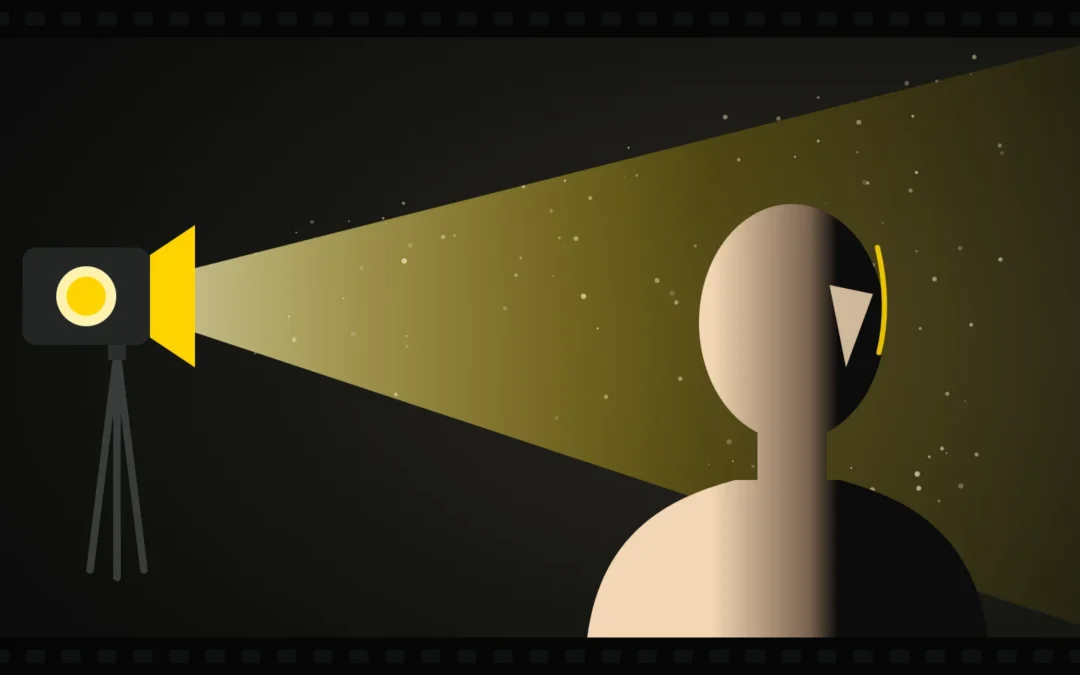
Before the camera, painters decided where the light came from. A window on the left, a candle on the table, a sun too high: every choice told something. On a set, a cinematographer does exactly the same, with lamps instead of brushes. Here are seven ways to light a scene, each inherited from a school of painting, with a diagram to understand it.
How to read the diagrams Each one shows, from above, the camera at the bottom, the subject in the centre and the lights around. On the right, the approximate on-screen result. The diagrams are simplified: in practice, height, distance and intensity are tuned to the centimetre.
1. Chiaroscuro: Caravaggio’s legacy
Around 1600, Caravaggio plunges his scenes into darkness and lets in a single, sharp beam from one side. Painting calls it chiaroscuro, or tenebrism when pushed to the extreme. In cinema we speak of low-key lighting: German Expressionism, then film noir, turned shadow into a character of its own.
The recipe: a single hard source, high and to the side, nothing in front, an unlit background. Best for: a dramatic portrait, a serious brand film, a luxury packshot. Contrast is high: exposure must be precise.
2. Rembrandt lighting
In the 17th century Rembrandt refines the method: the face is modelled by side light, and a small lit triangle appears on the cheek left in shadow. It has become the name of a technique found in countless portraits, from photography to film.
The recipe: a source about 45° to the side, a little above eye level, and if needed a discreet reflector to open the shadow. Best for: an executive interview, a corporate portrait with character.
3. Vermeer’s window
In Vermeer, light enters through a window on the left and caresses faces and objects. Shadows are tender, transitions long. It is soft light at its best: a large source, close to the subject.
The recipe: a large diffused source (a real window, or an LED panel with diffusion), close to the subject, and a white bounce opposite to keep detail in the shadow. Best for: customer testimonials, interviews, natural portraits. See our article on lighting a portrait and an interview.
4. Georges de La Tour’s candle
Georges de La Tour paints faces lit by a flame: low, warm, weak light that draws simple volumes. In cinema this is “motivated” light, justified by an object visible in the frame, called a practical. Stanley Kubrick took the idea very far in Barry Lyndon: some scenes are lit almost only by candles, thanks to exceptionally fast lenses (f/0.7). The film also openly draws on 18th-century English painting.
The recipe: a weak, warm source, low and close to the face, often visible in frame, with a sensitive camera and a fast lens. Best for: a restaurant, a workshop, an intimate moment, an evening mood.
5. The Impressionists’ backlight
Monet, Renoir and their friends leave the studio to paint outdoors. They care about light that changes hour by hour, halos, vibrating edges. In cinema we find this in backlight and in the “golden hour”, when the sun is low.
The recipe: the source (the sun or a lamp) sits behind the subject, a little high. The face is opened up with a bounce or a reflector in front, and exposure is watched so the background does not burn. Best for: exteriors, territory films, drone shots at sunrise or sunset.
6. Edward Hopper’s hard sun
In the 20th century, American realist painters, Edward Hopper among them, light their scenes with frank sunshine: sharp shadows, geometric shapes, slightly isolated figures. Cinema took up this light for westerns, road movies and sun-baked thrillers.
The recipe: a high sun, or a hard lamp, and shapes to carve the shadow (blinds, shutters, gobos). Best for: a graphic image, a portrait within architecture, an industrial world.
7. Three-point lighting: studio light
Classic studio cinema turned light into a system. The three-point method follows the logic of painted portraits: a main light (key) to model the face, a softer fill light (fill) to open the shadow, and a backlight (back) to separate the subject from the background.
The recipe: the key at about 45°, soft; the fill on the opposite side, generally two to four times weaker; the backlight behind, higher. Best for: most corporate content, as it is a reliable starting point.
At a glance
| Reference | Lighting | Mood | For your content |
|---|---|---|---|
| Caravaggio | One hard source, black background | Dramatic, solemn | Brand film, luxury packshot |
| Rembrandt | Source at 45°, triangle on the cheek | Portrait with character | Executive interview |
| Vermeer | Large soft side source | Calm, natural | Customer testimonial, portrait |
| Georges de La Tour | Low, warm flame | Intimate | Restaurant, workshop, evening |
| Impressionists | Backlight, golden hour | Luminous, alive | Outdoors, territory, drone |
| Hopper | Hard sun, sharp shadows | Graphic, solitary | Architecture, industry |
| Three-point | Key, fill, back | Balanced, readable | Corporate content |
Set vocabulary
- Fresnel: a lens lamp with an adjustable beam, the classic “hard” source.
- Softbox, diffusion: what enlarges and softens a source.
- Flag: a black panel that cuts light where you don’t want it.
- Gobo: a cut-out pattern that casts a drawn shadow.
- Bounce: a white or silver surface that sends light back to the subject.
Why it matters for your project
Light is the first language of a film or a photo. Before talking gear, it is better to know what feeling you are after. A reference painting or film is often worth more than ten adjectives: if you have one in mind, send it to us. For colour and mood in post-production, see also our article on colour grading, and for kit, our equipment.
A mood in mind?
Tell us what you want people to feel: we will suggest the lighting that goes with it.
Further reading: “Barry Lyndon” and the f/0.7 lenses, the English paintings that inspired Kubrick (Phaidon). The diagrams in this article are original, simplified illustrations.