
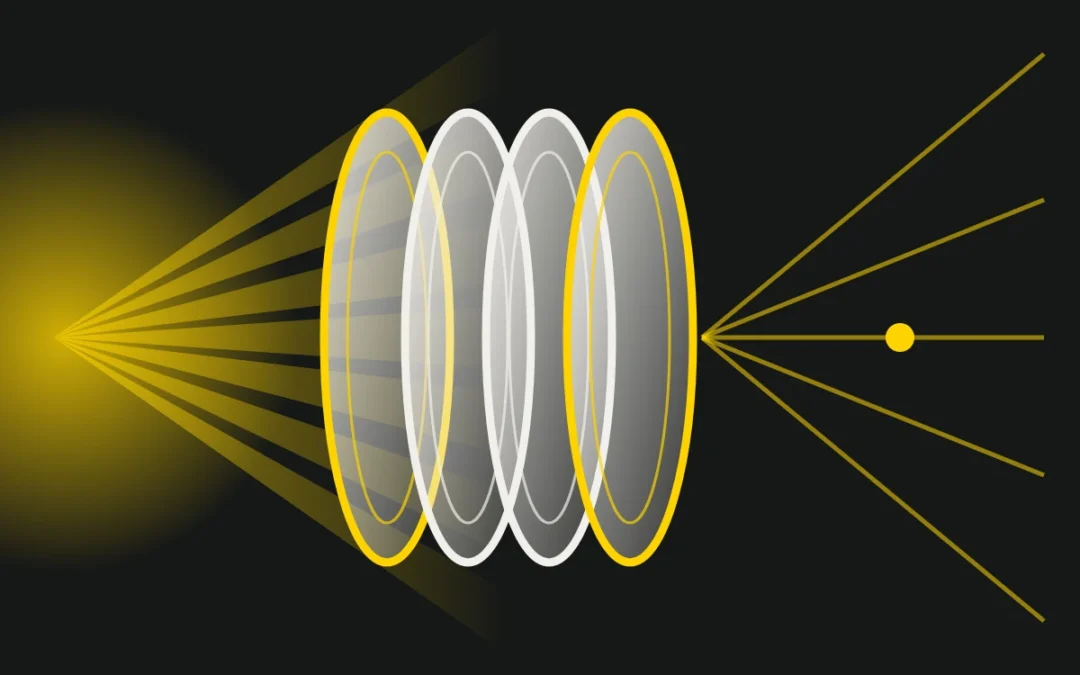
A filter sits in front of the lens and changes the light before it reaches the sensor. Some filters are purely technical (ND), others shape the image (diffusion). Here are the families used on a shoot, what they do and how we choose them.
Where does a filter go?
On a photo lens, the filter screws onto the front. On a film shoot, we use a matte box that takes rectangular filters of 4 × 5.65 inches, 4 × 4 or 6.6 × 6.6 inches, swappable in seconds and stackable. Some cameras also have built-in internal ND filters.
ND (neutral density) filters
An ND filter cuts the light without changing colour. In bright sun, it lets you keep a wide aperture for a soft background while holding a shutter speed close to 1/50 s at 25 frames per second, the 180° shutter.
- ND 0.3, 0.6, 0.9: 1, 2 or 3 stops less, for overcast days or moderate light.
- ND 1.2 and above: 4 stops and beyond, for full sun at a wide aperture.
- IRND: some sensors are sensitive to infrared; with a strong ND, blacks can turn magenta or brown. An IRND also filters infrared to prevent this.
- Variable ND: handy for photo and run-and-gun, but it can add colour casts or a dark cross pattern at high density. For demanding shoots we prefer fixed NDs.
The polariser
A polarising filter reduces reflections on water, glass or leaves, darkens a blue sky and adds depth to colours. It removes about one and a half to two stops. You adjust it by rotating it, and its effect depends on the angle to the sun. It is valuable for real estate, the sea and shop windows.
Graduated ND filters
A graduated ND is tinted on one half and clear on the other. Placed with the dark part over the sky, it balances the exposure of a landscape. It comes in soft or hard transition; an uneven horizon (trees, buildings) shows quickly.
Diffusion filters
Modern sensors are very sharp. Diffusion filters soften the image: they make light sources bloom slightly, reduce local contrast and flatter faces.
- Pro-Mist and Black Pro-Mist: a glow around highlights. Black Pro-Mist protects blacks more; Pro-Mist lifts them slightly. Grades run from 1/8 to 2 and beyond.
- Hollywood Black Magic and Glimmerglass: variants that bloom sources and texture more or less.
- Classic Soft and Soft/FX: soften mostly detail and skin, with less halo.
- Streak filters: horizontal streaks around light sources, inspired by anamorphic.
How to choose
| Filter | Effect | Typical use | Watch out |
|---|---|---|---|
| Fixed ND | Less light | Exteriors, wide aperture | IR on some sensors |
| IRND | Less light, no IR drift | Strong ND | Cost |
| Polariser | Reflections, sky, saturation | Real estate, sea, windows | Loses 1.5 to 2 stops |
| Graduated ND | Balance the sky | Landscapes, drone | Uneven horizon |
| Black Pro-Mist 1/8 to 1/4 | Softens, subtle glow | Interviews, lifestyle | Test with your sources |
| Strong diffusion | Dreamy mood | Fiction, music video | Loss of sharpness |
Our approach. A suitable ND to keep the right shutter speed, a light Black Pro-Mist to soften images that are too sharp, and always a test before the shoot: the effect depends on the lens, the aperture and the sources in the frame. Our gear is on our equipment page.
Diffusion is hard to simulate in post-production: the glow is born in the optics and follows the real light. An ND, meanwhile, is essential to keep a cinematic look in daylight.
A look to define for your film?
Tell us the mood you are after: we choose the lenses and filters.