
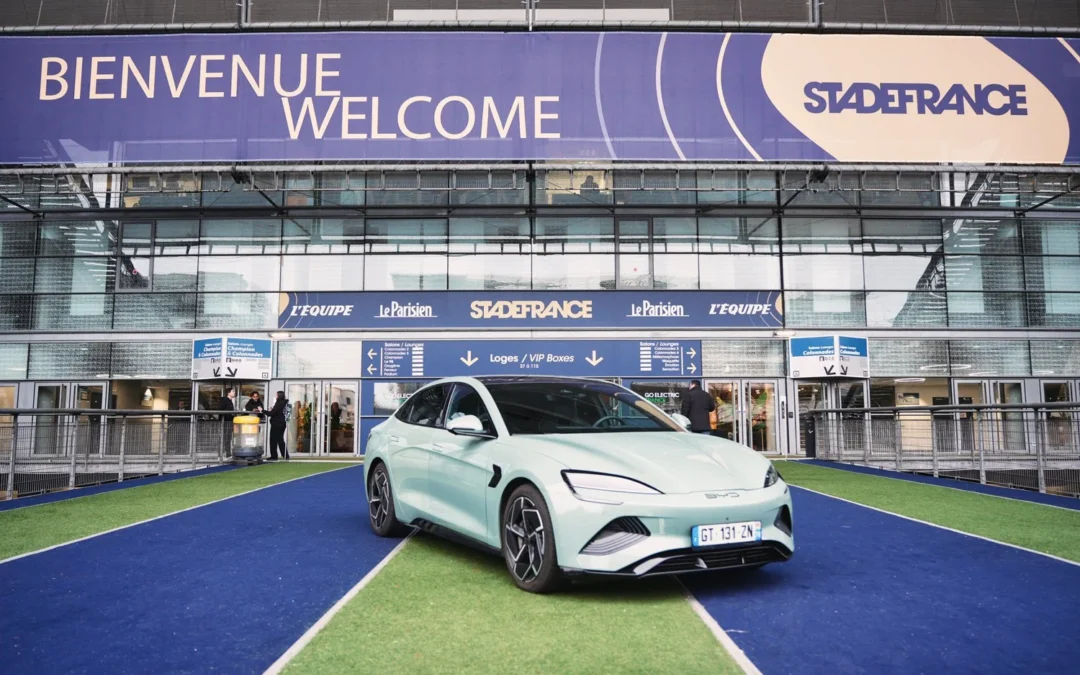
A black saloon, low sun, a country road: on paper, it’s the dream shot. In reality, it’s a 4.5-metre-long mirror that reflects your crew, your sky and your tracking vehicle. Filming a vehicle is a precision craft. Here are the questions we get asked most often.
Why is a car so hard to film?
Because the bodywork is a curved mirror. Every shiny surface reflects what surrounds it: the camera operator, the lights, a building. The challenge is therefore not to light the car, but to control what it reflects.
Professionals work with large, soft sources (a softbox, a diffusion frame) positioned to draw lines of light along the flanks. A polarising filter on the lens cuts down some of the reflections. Outdoors, we choose the time of day and the orientation of the vehicle so that the sky, not the car park, is reflected in the windows.
How do you shoot a tracking shot with a car?
There are three main techniques:
- The camera car: a second vehicle drives alongside, with an operator and a stabilised camera, to film the model in motion.
- The suction mount: a camera attached to the bodywork with professional suction cups. It gives those shots very close to the road, or on the wheel.
- Static or rail shots: for stops, entrances into the frame, details of the headlights or the interior. We use a slider, a stabiliser or a crane.
Tip The suction mount comes with a rule: respect the maximum load stated by the manufacturer, back up the attachments with a safety cable, test at low speed before driving, and check the mount between each take. This is not equipment to improvise with, and never on fragile bodywork or a dusty surface.
Can you shoot on public roads however you like?
No, and this is a point to check before choosing the location. There is no single filming permit valid everywhere in France: each place has its own rules and its own point of contact.
- Outside Paris: you generally contact the town hall of the municipality concerned, which can direct you to the prefecture if it is not the competent authority. Local film commissions can also help.
- In Paris: the City distinguishes between a simple prior declaration for small crews (fewer than 10 people, light equipment, no special parking), to be filed 5 working days beforehand, and an authorisation request for all other cases, 15 working days beforehand. Insurance is required, and the Préfecture de police is also involved for filming on public roads.
- Closed road or modified traffic: it is the authority that manages the road (municipality, département or State depending on the road) that can authorise it by order. Allow plenty of time, because the lead times are not those of a simple declaration.
Another limit: the highway code still applies. A film convoy gets no special treatment: you respect the speed limits, you don’t obstruct traffic, and a camera mounted on the outside must never put a third party at risk. For filming on a private circuit or in a closed car park, it is the owner who gives permission. It is often the simplest solution for a launch.
And what about a vehicle packshot?
A car packshot is a photo or video on a neutral background or in a controlled setting, with no stray reflections. It is done in a studio or a large covered space, with controlled lighting, and is used for catalogues, listings and websites. For used vehicles at a dealership, a consistent series (same angles, same light, same background) is a real argument for trust: the customer sees exactly what they are buying. Our article on product packshots explains the method.
The delivery video: the idea people underestimate
The day a customer picks up their vehicle is when they are happiest in their relationship with your brand. A short video of the key handover, with their agreement, is worth any slogan: a smile, a gleaming car, an adviser by their side. The customer happily shares it, and your teams are proud of it. You just need to obtain their written consent and specify where the video will be shown and for how long.
Key points before you shoot
- Choose the location according to the authorisations, not the other way around.
- Check the filming insurance and the vehicles’ insurance.
- Plan the time of day: low-angle light limits harsh reflections.
- Clean the vehicle on site, including the wheels and the interior.
- Appoint a person in charge of safety on the shoot.
At that dog, we have a car suction mount, a stabiliser, a slider and a crane, as well as a packshot set and lighting suited to shiny surfaces. We prepare with you the location, the authorisations to request and the schedule for the day, so that most of the time goes to the images.
Going further
This article offers general guidance and does not replace legal advice.
Your next vehicle in pictures
Dealership, launch, delivery: tell us about your project, and we’ll tell you how to shoot it safely.