
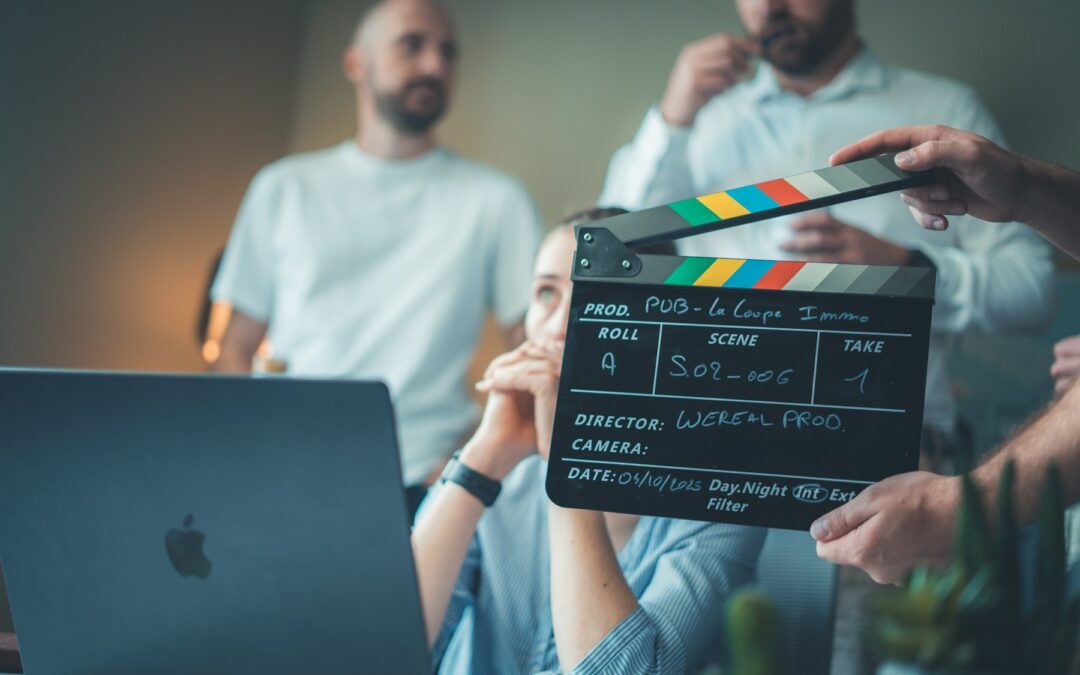
Nobody ever said “what a nice brochure” on leaving a cinema. We remember stories. Yet most company videos begin with “Founded in…” and end with “don’t hesitate to contact us”. There’s something better to tell.
The hero is your customer
It’s the most common mistake: taking the company as the main character. But the hero of the story is the person watching you. Your role is that of the guide, the one who knows the way and hands over the right key at the right moment. In other words: talk less about yourself, more about what your customer experiences, fears and hopes for.
A brand that talks about itself attracts few. A brand that tells its customer’s story makes people want to join it.
Three acts, no more
- Act 1, the situation and the problem. An everyday life, then a spanner in the works. The problem creates the tension; without it, nobody stays.
- Act 2, the ordeal. We search, we try, we hesitate. This is where your know-how appears, in action, not as a slogan.
- Act 3, the change. The situation is no longer the same. We show the result, and let it breathe.
The problem first
A film without a problem is a guided tour. Name the difficulty clearly and early: the bread that doesn’t last the day, the late delivery, the decision put off for months. Your prospects will recognise themselves, and that’s exactly what you want.
Senses before adjectives
“Artisanal know-how” produces no image. A crust that crackles, flour drifting down through a ray of light, the sharp sound of a machine stopping: that is sensory detail. Sound matters as much as picture. A tight shot of hands at work says more than a paragraph.
Tip For each sentence of your script, ask yourself: what could we see or hear instead? If the answer exists, delete the sentence.
Show, don’t tell
Saying “we listen” is free. Showing an adviser who rephrases, takes notes, and comes back the next day with a solution is convincing. Every quality you claim must be turned into a scene. Otherwise, it has no place in the film.
Three mini-scenarios (fictional)
These examples are made up, to illustrate the method. None corresponds to a real client.
The bakery
Hero: a local resident preparing an impromptu dinner. Problem: it’s 6:40 p.m., she has planned nothing. Act 2: she pushes open the door, the smell grabs her, the baker suggests a bread she wouldn’t have chosen. Act 3: the table, the laughter, the baguette broken by hand. Not a single sentence about the “quality of the products” is needed.
The industrial SME
Hero: a production manager at a client company. Problem: a line stops because of a missing part, and every hour counts. Act 2: in the supplier’s workshop, a team urgently machines the part; we see the gestures, the precision, the checking. Act 3: the line restarts, the noise returns. The message is clear without a word about “responsiveness”.
The consulting firm
Hero: an SME director hesitating over reorganising her team. Problem: the meetings go round in circles. Act 2: a working session, a board filling up, an idea that changes the discussion. Act 3: a few months later, the same room, the atmosphere has changed. No charts, just a before and an after.
What it changes for you
| What’s often said | What to show instead |
|---|---|
| We listen | An adviser who rephrases and comes back with a solution |
| Quality products | The gestures, the materials, the sound of the product |
| Responsiveness | An emergency resolved, from the call to the result |
| Passionate team | A colleague explaining their job with a laugh |
A good story isn’t made on screen, it’s prepared beforehand: you choose the hero, formulate the problem, scout the places and gestures that speak, and decide what will be said aloud and what will be shown.
This is the work we love doing at that dog: finding, with you, the story that’s already inside your company, then shooting it with the picture, light and sound it deserves. If you’d like to see how it’s prepared, our guide to briefing a videographer is a good start.
Shall we tell yours?
Come with an idea, a client, a problem solved: we’ll turn it into a story worth watching.