“Let’s go again, there’s a boom pop in the frame.” If that sentence sounds like a foreign language, don’t worry: that’s normal. Film sets have their own vocabulary, a mix of English, technical slang and old cinema traditions.
Here are 30 words to help you follow the conversation on shoot day, understand a quote without frowning and, who knows, shine at the coffee machine.
On set
- Set: the place where we shoot. It can be a studio… or your meeting room for the day.
- Take: each attempt at the same shot. “Take 7” doesn’t mean you’re bad, just that the plane has flown over six times.
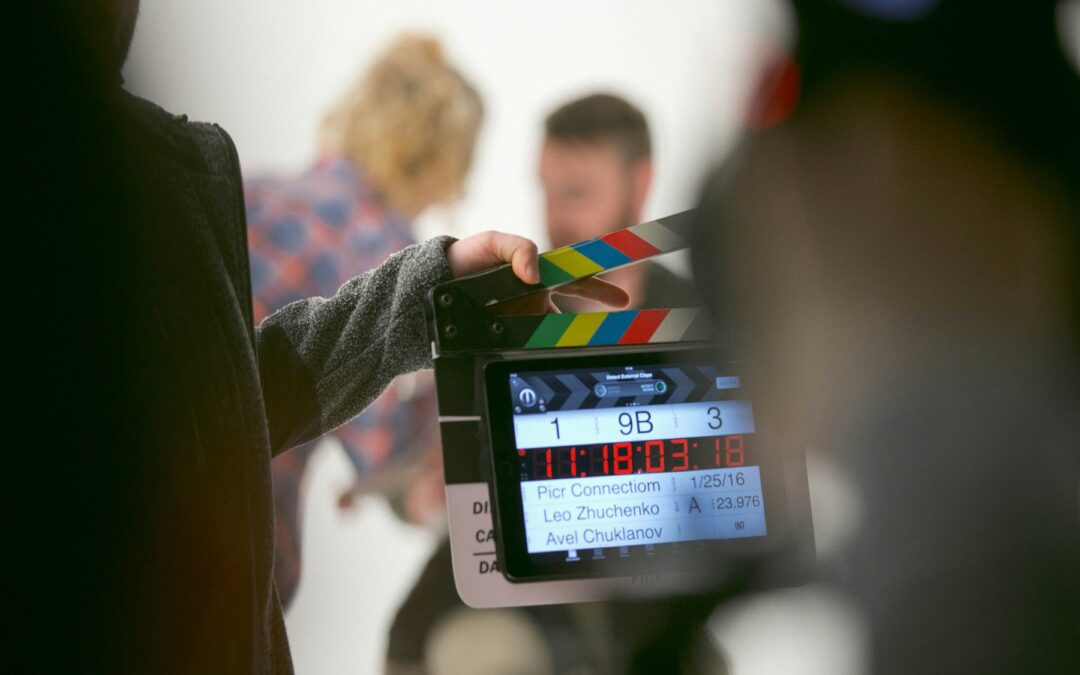
- Clapperboard: the famous slate that claps. It shows the shot and the take, and its “clap” serves as a marker to sync sound to picture in the edit.
- Timecode: the internal clock of cameras and recorders (hours, minutes, seconds, frames). It lets us find and synchronize any moment.
- Video monitor: the screen where you can see, live, what the camera is filming. That’s where you can approve the framing without looking over the camera operator’s shoulder.
- “That’s a wrap”: everyone’s favorite phrase. The shot is good, we move on to the next one.
The image
- Frame: what you see on screen. What’s out of frame doesn’t exist… except the forgotten coffee cup in a corner, which always shows.
- Focal length: the “power” of a lens. A short focal length shows a wide view, a long focal length brings things closer and compresses perspective.
- Depth of field: the sharp zone of the image. Shallow, it separates the person from a blurred background; deep, everything is sharp from foreground to horizon.
- Frame rate: the number of images per second. In France, we often deliver at 25 frames per second.
- Slow motion: we film at a higher frame rate than the playback rate. Filmed at 100 frames per second and played at 25, a gesture lasts four times longer. Guaranteed effect on a falling drop.
- Log: a recording mode that gives a gray, “washed-out” image straight out of the camera, but keeps as much information as possible in the shadows and highlights.
- RAW: the raw sensor data, before the camera decides the colors for you. The digital negative, in short.
The shots
- One-take shot: an entire scene filmed without a cut. Impressive, demanding, and everyone holds their breath until the end.
- Shot / reverse shot: we film one person, then the person facing them. The basics of dialogue.
- B-roll / cutaways: the illustrative images (hands at work, workshop, details) that slip over an interview. Without them, you’re watching a talking head for two minutes.
- Tracking shot: a movement where the camera physically moves, on a rail, slider or vehicle, and doesn’t just pivot on the spot.
- Packshot: the “portrait” photo or video of a product, clean and precise, often on a neutral background.
The sound
- Boom pole: the long pole with a microphone attached at the end, held above the actors. The boom operator has the most enduring arms on set.
- Lavalier: the small mic clipped to a collar or hidden under clothing. Nothing to do with your outfit.
- Sound check: setting the sound levels before shooting. Yes, we’ll ask you what you ate this morning, it’s to set the mic.
- Room tone: a few seconds of the room’s “silence,” recorded separately to help with mixing. The only moment when everyone really goes quiet.
Tip On shoot day, if you don’t understand a term, ask. A professional crew likes to explain, and it will keep you from approving a shot without knowing what you’re approving.
In post-production
- Rushes: all the raw footage shot. There’s always much more than what will be kept.
- Footage review: sorting through those rushes. We watch everything, note the best takes, set aside the sneezes.
- Color grading: working on color and light, shot by shot, to harmonize the footage and create a mood.
- LUT: a color conversion table. A kind of “recipe” that turns a log image into a watchable one, or gives a starting look.
- Sound design: creating the sound world, effects, ambiences, small touches, so that the image “sounds” right.
- Motion design: the graphic animation of text, logos, figures or icons. What makes an Excel table almost glamorous.
- Master: the final version, in full quality, from which all formats are derived.
- Delivery file (ready to broadcast): the final file that meets the technical standards required by the broadcaster. The last link in the chain.
A good shared vocabulary means fewer misunderstandings and more time for what matters: the image.
At that dog, we don’t use jargon to impress: we use it to work fast and precisely, and we’re happy to translate it for you. If you’re curious to see what a boom pole, a slider or a softbox looks like, the studio’s equipment is presented in detail.
Ready to go from theory to the set?
Let’s talk about your next shoot, and we’ll explain every step in plain English.